

Our Methodology In 2026
We aim to help traders find the best forex broker that meets their needs. Our comparisons are based on platform features, trade costs, and execution speeds.
Our 2026 methodology ranks 67 brokers based on eight categories, drawing on over 100 data points collected per broker across all categories. Our research team publishes a review for each broker, and our technical researchers perform testing using automation – Expert Advisors, Indicators and Scripts.


Our broker reviews are reader supported and we may receive payment when you click on a partner site.
CompareForexBrokers Methodology
We have reviewed over 67 established forex and CFD brokers, and this number continues to grow with a major focus on firms that are regulated and active in major global markets. While most brokers product range is similar across the globe, there are occasional differences due to regulatory and even licensing limitations. For this reason, our reviews are designed to reflect the regulatory standards and trading conditions that apply to the region we review.
Regulation is assessed on a regional basis, with priority given to brokers authorised by well-recognised regulators. This includes the FCA in the UK, ASIC in Australia, CySEC and other recognised EU regulators in Europe, the NFA and CFTC in the United States, CIRO and provincial regulators in Canada, the DFSA, SCA and ADGM in the UAE, and the FMA in New Zealand.
In limited cases, we may include brokers based offshore for certain regions. This only occurs where the broker has an established operating history, a strong reputation, and credible regulatory oversight in at least one recognised jurisdiction. When including offshore brokers for the jurisdiction being reviewed, we always clarify that the broker is not directly regulated in that region, In some cases, however, we find their benefits compelling.
While we do review unregulated brokers, we have yet to formally recommend any. We believe there are no benefits that outweigh their risks (whether real or imagined).
Our coverage is deepest in Australia and the United Kingdom, where we conduct the most frequent testing and updates. We also maintain substantial coverage of Canada, the United States, and the UAE, with growing focus on Thailand. Other regions, including the European Union and parts of Asia such as Malaysia, are also covered where broker offerings and regulation meet our standards.
Our Scoring System
Our comparison of forex brokers is the work of a team of traders and industry experts. It’s based on rigorous testing, research and our experience using each broker. We use a model with eight weighted criteria to formulate our comparisons.
| Trading Costs | Trading Experience | Trust | Trading Platforms | Customer Service | Range of Markets | Education | Funding | |
|---|---|---|---|---|---|---|---|---|
| Weighting | 25% | 15% | 20% | 15% | 10% | 5% | 5% | 5% |
On this page, you’ll learn what factors we use to score each of these criteria, to make up our overall broker score.
How we collect data and test brokers
Before starting, it helps to clarify how we do our testing.
Our writers are experienced traders themselves, so they understand exactly what matters most when choosing a broker. While we gather information from a broker’s own website, we don’t rely on this alone. We conduct hands-on testing by opening accounts ourselves to see how brokers operate in real trading conditions, rather than relying only on published specifications. Testing is conducted using live accounts which means using our own funds to meet minimum deposit requirements and make a trade. Platform testing covers Windows desktop, macOS, iOS and Android devices running current operating systems.
Using such accounts allows us to test the full client experience, including account setup, platform access, funding, withdrawals, and ongoing trading conditions.
We have a team that fact-checks and records all broker information in a spreadsheet, which is then provided to our writers who confirm these details as part of their testing. All data is cross-checked before publication to minimise errors across the 100+ data points we collect per broker each review cycle.
Our Testing Environment
Spread testing is conducted using live RAW/ECN accounts — not standard or zero-commission accounts — to reflect the tightest pricing conditions available to traders. The same process is applied separately for standard accounts. Testing covers six major currency pairs: AUDUSD, EURUSD, GBPUSD, USDCAD, USDCHF and USDJPY.
Spreads are recorded using IceFX SpreadMonitor, a freely available MT4 indicator that captures minimum, maximum and average spread values at the hourly (H1) interval and exports results to CSV for analysis. Each test runs across a full 24-hour period, covering all major forex sessions — Sydney, Tokyo, London and New York. Tests begin at 2:00 PM Brisbane time (UTC+10), which represents the lowest-volume point of the forex trading day, before running overnight through periods of peak liquidity.
Execution speed testing is conducted across RAW/ECN accounts at 15+ brokers using two MT4 Expert Advisors purpose-built for this task.
For limit orders, we use ExTest_ForExpat, which places multiple buy and sell orders and records the minimum, maximum and average response time between order submission and broker acknowledgement. For market orders, we use Broker Latency Tester, which submits an order, records the time to execution confirmation, then closes the position — averaged across 20 trades at each broker’s minimum lot size.
To ensure results are location-independent, we subtract network latency (ping) between our testing machine and each broker’s server from the overall execution time. This means results are comparable regardless of where our testing machine is located — server location differences between brokers do not skew the outcome.
VPS testing is conducted across 15 providers to benchmark the setups most commonly used by algorithmic and EA traders. Tests focus on cross-connected configurations at the LD4 (London) and NY4 (New York) data centres, which co-locate with the majority of broker servers. Full results are published on our VPS speeds page.
Category scoring and final scores
Each major evaluation area is scored on a 0 to 10 scale, based on a mix of measured data and hands-on testing. These category scores are combined and weighted to produce a final score out of 100, which is used for rankings and comparisons across the site.
Areas that have a direct impact on trader risk and ongoing costs, such as regulation, trading costs, and platform reliability, are weighted more heavily than secondary features. This helps ensure rankings reflect practical trading considerations rather than cosmetic extras.
Account Opening
Account opening is evaluated as a standalone part of our methodology. We compare how easy it is to open (and how long it takes) an account, what documentation is required, and how clearly brokers explain account types, pricing, and platform access during signup.
This testing forms the basis of our account-opening comparisons, which are explained in more detail on our account opening methodology page.
Forex Trading Account Spreads and Fees
Trading costs are assessed using a combination of broker-published data and live platform testing. We collect minimum and average spreads published by brokers for major forex pairs and compile them into tables so pricing can be compared consistently.
To validate published pricing, we also conduct live spread testing conducted by Ross Collins, our Technical Research Lead with 35 years of IT experience at SWIFT, UBS, PwC and IBM, using MetaTrader 4 and the IceFX SpreadMonitor tool. Spreads are recorded under consistent conditions across brokers for both standard and raw account types.
Our spread testing methodology is detailed here:
1. Raw account spread testing:
2. Standard account spread testing:
Commission-based pricing is assessed separately. We record commission rates for major base currencies, including AUD, USD, EUR, and GBP, and compare how these affect overall trading costs.
Brokers with consistently lower overall trading costs tend to score more strongly within the trading cost category, alongside execution quality and pricing transparency. For this reason, we weight our scoring based on the different types of costs.
| Standard Published Spreads | Standard Tested Spreads | RAW/ECN Published Spread | RAW/ECN Tested Spread | Published Commission Rates | Inactivity Fees | Deposit / Withdrawal Fees | Active Trader Discount | Fixed Spreads | Other Fees | |
|---|---|---|---|---|---|---|---|---|---|---|
| Weighting | 20% | 15% | 15% | 10% | 15% | 5% | 5% | 5% | 5% | 5% |
Forex Broker Trading Experience
The top factors in our trading experience scores are our tested limit order and market order speeds. Our model prioritises the availability of standard accounts (based on spreads) and raw/ecn (commission-based accounts) and the facility of higher leverage for professional traders.
| Limit Order Speed | Market Order Speed | Ease of Opening | Ease of Withdrawal | Professional Leverage | Standard Account | Raw Account | Fixed Spread Account | Islamic Account | Account Manager | |
|---|---|---|---|---|---|---|---|---|---|---|
| Weighting | 15% | 15% | 15% | 10% | 10% | 10% | 10% | 5% | 5% | 5% |
About Execution Speed
Ross Collins performed extensive execution speed testing using ExTest_ForExpat and a custom Broker Latency Tester EA to determine the execution speed quality of market orders and limit orders. The methodology and test results can be found on our execution speed test results page. These tests were done over two weeks to help negate abnormalities and give better confidence in tested results. Execution speed can be important where slippage is a major concern.
Execution testing is used for relative comparison between brokers rather than to guarantee performance at all times.
VPS Speed Testing
We benchmark Virtual Private Server (VPS) providers commonly used by algorithmic and EA traders. Testing covers connection latency, uptime, and execution reliability across 15 VPS providers. Full results are published on our VPS speeds page.
Forex Broker Trust and Reputation
We consider appropriate licensing by a national regulator a core element of the trust a trader can place in a broker. Financial regulators develop and enforce the rules, policies and procedures that govern how financial services providers behave, and trading with a licensed broker can offer significant protections against fraud, theft, and misuse of your funds.
Other factors that influence our trust scores include: the age of the broker, whether they have headquarters (or offices) in multiple countries and whether they’ve had any recent issues with their core regulators.
| Tier 1 Regulators | Tier 2 Regulators | Tier 3 Regulators | Age of Broker | Headquarters | Search Volume | Core Regulator Issues | TrustPilot Score | Publicly Listed | Bank | |
|---|---|---|---|---|---|---|---|---|---|---|
| Weighting | 30% | 15% | 5% | 10% | 10% | 10% | 10% | 5% | 3% | 2% |
What is a financial regulator?
In most sophisticated economies, a government ministry or agency holds responsibility for overseeing and monitoring financial institutions and markets. These regulators seek to maintain the stability, integrity, and fairness of the financial system to protect the interests of consumers, investors, and the overall economy.
Not all jurisdictions afford their regulators the same degree of influence, however. A country with a commitment to free markets and minimal regulation, for example, might not permit certain interventions during market downturns. A country with a strong culture of privacy might require additional controls on financial data.
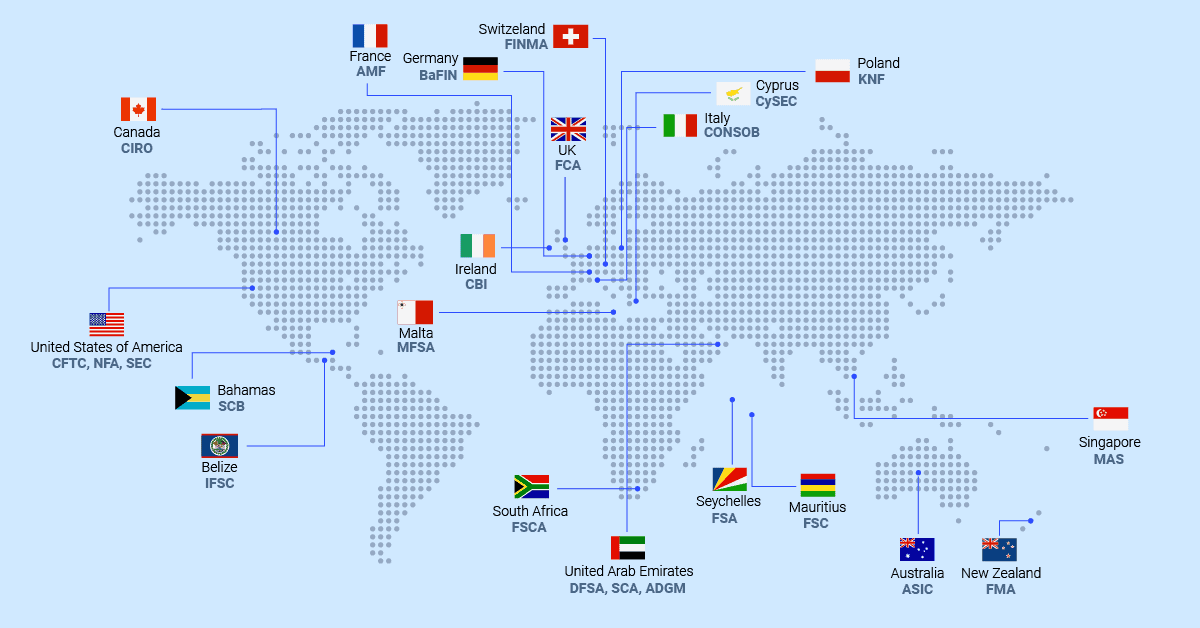
At CompareForexBrokers, we’ve broken financial regulators into tiers based on strength of their regulations, extent of their oversight infrastructure, and supervisory power.
Tier 1 regulators offer the highest level of consumer protection and oversight. While trading with a Tier 1 regulator doesn’t guarantee you won’t lose money, it does mean you can feel confident that the broker must abide by certain rules around protecting your money.
The following table lists out our Tier 1 regulators.
| Tier 1 Regulators | Abbreviation | Region |
|---|---|---|
| Australian Securities & Investment Commission | ASIC | Australia |
| Financial Conduct Authority | FCA | United Kingdom |
| Commodities Future Trading Commission | CFTC | USA |
| National Futures Association | NFA | USA |
| Cyprus Securities & Exchange Commission | CySEC | Cyprus |
| Swiss Financial Market Supervisory Authority | FINMA | Switzerland |
| Canadian Investment Regulatory Organization | CIRO | Canada |
| Monetary Authority of Singapore | MAS | Singapore |
| Federal Financial Supervisory Authority | BaFIN | Germany |
Tier 2 regulators may exercise some of the same powers and insist on many of the same safeguards as their Tier 1 counterparts, but lack other important protections. While we consider brokers licensed Tier 2 regulators generally trustworthy, be aware that they may not be required to exert the same degree of control over client funds as a Tier 1-regulated broker. In other cases, Tier 2 regulators may form part of a less developed financial system still developing some of the institutions required to provide adequate oversight.
The following table lists out our Tier 2 regulators.
Tier 3 regulators control “offshore” brokers and seldom offer the same degree of protection and oversight as those in the Tier 1 and Tier 2 band. Brokers who are only regulated at this level can be assigned a lower level of trust.
The following table lists out our Tier 3 regulators.
Tier 4 regulators
| Tier-4 Jurisdictions (Low Trust Level Regulator) | Abbreviation | Country |
|---|---|---|
| Financial Services Commission Jamaica | FSC-JM | Jamaica |
| Securities and Exchange Commission of Pakistan | SECP | Pakistan |
| Financial Regulatory Authority | ASFI | Bolivia |
| Bank of Botswana | BOB | Botswana |
| Superintendencia De Banca | SBS | Peru |
| Central Bank of Guatemala | BANGUAT | Guatemala |
| Central Bank of Honduras (Banco Central de Honduras) | BCH | Honduras |
Tier 5 regulators
Broker safety and trust are assessed using multiple inputs. Regulation forms the foundation of this assessment, with greater weight given to brokers authorised by well-recognised financial regulators.
We also review a broker’s operating history, public disclosures, and any material regulatory or legal actions where relevant. Additional signals, such as independent user feedback and public complaints, may be reviewed to provide context but do not override regulatory status or direct testing outcomes.
Forex Trading Platforms
We assess trading platforms based on what brokers actually make available to clients, including both widely used third-party platforms and proprietary systems. Platform availability is confirmed using live accounts rather than marketing material.
Our testing covers platforms such as MetaTrader 4, MetaTrader 5, TradingView and cTrader, as well as broker-developed platforms where offered. We also record which platforms are supported across different devices and operating systems, including web-based platforms, Windows, macOS, iOS, and Android.
We also believe it’s important for brokers to offer a free, non-expiring demo account so that traders can thoroughly test their strategies before committing financial resources. We also consider it important that brokers allow limitations regarding automation and scalping.
| MetaTrader 4 | MetaTrader 5 | cTrader | TradingView | Free Demo Account | Demo Account Expiry | Social/Copy Trading | Automation/Scalping | Proprietary Platform | Mobile Trading App | |
|---|---|---|---|---|---|---|---|---|---|---|
| Weighting | 15% | 15% | 10% | 10% | 10% | 5% | 10% | 10% | 5% | 10% |
Trading Tools And Functionality
We review the availability of practical trading tools that support different trading styles. This includes risk management features such as guaranteed stop-loss orders, automation and algorithmic trading support, and social or copy trading functionality where offered.
Platform usability, stability, and feature depth are considered alongside tool availability. Platform features contribute to overall scoring but do not outweigh regulation or trading cost considerations.
Forex Broker Customer Service
Customer support is tested as part of our review process to assess how responsive and helpful brokers are when traders need assistance. We primarily test support through live chat, as this is the most commonly used channel for retail traders.
During testing, we check whether responses are handled by human agents or automated systems, how long it takes for a human representative to respond, and how clearly and accurately questions are answered. We also assess whether support staff demonstrate practical knowledge of the broker’s platforms, account types, and pricing.
Support hours and available languages are recorded. Customer support contributes to overall broker scores, though it is weighted lower than core factors such as regulation, trading costs, and platform reliability.
We have also tracked the number of awards brokers have won at Investment Trends since 2020.
| Live Chat | CS Knowledge | FAQ / Knowledge Base | Metatrader Guides | Email, Social Media | Support Hours | Investment Trends Awards | CS Languages | Account Manager | Website Experience | |
|---|---|---|---|---|---|---|---|---|---|---|
| Weighting | 15% | 15% | 15% | 5% | 10% | 10% | 5% | 5% | 10% | 10% |
Forex Broker Education
Our scoring methodology for education resources concentrates on two dimensions – the experience level of the trader and the channels used to deliver training. We give a high weight to help for beginners, a medium weight to intermediate education and a lower rating for expert resources. Articles, blogs, webinars, eBooks and YouTube are considered delivery channels. We also like to see an in-house analyst at a broker, providing commentary and analysis of market trends, and we always find an excellent glossary helpful.
| Beginner Resources | Intermediate Resources | Expert Resources | Market Research, Analysis | In-house Analyst | Articles, blogs | Webinars | eBooks | Glossary | Youtube | |
|---|---|---|---|---|---|---|---|---|---|---|
| Weighting | 15% | 10% | 5% | 10% | 10% | 10% | 15% | 15% | 5% | 5% |
Range of Markets
The range of markets offered by a broker is assessed directly through the trading platforms we test. Instead of relying only on marketing claims, we count the number of available instruments by asset class using the live accounts we have opened. We are not aware of any other broker comparison website that does this.
This approach helps ensure that listed markets are actually accessible to traders on the platforms and account types being reviewed.
As a site focused on forex, our range of markets scores naturally favours brokers with many forex pairs available for trading. Other products we count include
1. Cryptocurrencies
2. Commodities (hard and soft – including metals like gold and silver, energies like oil and gas and agricultural commodities like coffee and sugar).
3. Indices and ETFs
4. Bonds and treasuries
5. Stocks (CFD and underlying)
6. Other products (e.g. options, futures, interest rates)
| Forex | Share CFDs | Crypto CFDs | Commodities | ETFs | Indices | Bonds / Treasuries | Spread Betting | Other Products | Shares | |
|---|---|---|---|---|---|---|---|---|---|---|
| Weighting | 25% | 15% | 10% | 10% | 5% | 10% | 5% | 10% | 5% | 5% |
Forex Broker Funding Methods
To provide a score on funding (i.e., making deposits), our methodology considers the breadth of available base currencies as the most critical factor. We then award brokers scores based on the funding methods available (credit card, bank transfer, etc.). We review banking trends to align our weightings with the most popular funding methods.
| Base Currencies | Visa / Mastercard | Wire Transfer | Paypal | Neteller | Skrill | Rapid Pay EUR/GBP | POLi / bPay AU/NZ | Amex | Klarna | Union Pay | |
|---|---|---|---|---|---|---|---|---|---|---|---|
| Weighting | 20% | 15% | 15% | 15% | 10% | 5% | 5% | 5% | 3% | 2% | 5% |
How Often Do We Update Our Data
Published spread data is reviewed and updated monthly to reflect current broker disclosures and pricing conditions. When reviewing the module, you can see the date of the last update at the bottom of the spreads module.
Full broker reviews are formally reviewed and refreshed at least once per year, typically in January. During these reviews, we check that regulation, pricing structures, platforms, and product offerings remain accurate.
If material changes are identified outside the scheduled review cycle, such as regulatory updates, pricing changes, or platform modifications, we update the relevant sections when identified rather than waiting for a full rewrite.
CompareForexBrokers independence and commercial relationships
CompareForexBrokers operates independently and applies a consistent methodology across all broker reviews and comparisons. As a certified B Corporation, we are independently assessed against standards of social and environmental performance, accountability, and transparency.
Our testing, scoring, and editorial decisions are not influenced by commercial relationships.
We may earn a commission when readers choose to open an account with a broker through our site. This does not affect how brokers are tested, scored, or ranked. Advertisers do not have the ability to influence our methodology or review outcomes.
Further details are available here:
Have a question about our methodology or want to suggest an improvement? Contact us.
About CompareForexBrokers:
Who conducts and reviews our testing
Our broker reviews and comparisons are produced by traders with hands-on experience using retail trading platforms. Testing and analysis are carried out using live accounts and real trading environments where possible.
All reviews are checked and overseen by David Levy, who acts as the final content reviewer. David has been reviewing forex brokers since 2018 and brings long-term familiarity with broker platforms, pricing models, and regulatory differences across regions. This review process helps ensure consistency, accuracy, and practical relevance across the site.
What we do not test or guarantee
Our testing focuses on broker features, pricing structures, platforms, and regulatory standing. We do not test individual trading outcomes or attempt to predict market performance.
Execution speeds, spreads, and pricing data shown on the site are indicative, based on testing conducted under specific conditions. They do not guarantee that every trade will receive the same results, as market conditions, liquidity, and account settings can change.
We also do not assess trading strategies, personal risk tolerance, or whether a broker is suitable for an individual trader’s circumstances.


